Summary
When delivery feels slow, unpredictable, or stressful, most organisations reach for “more process”, “more governance”, or “more meetings”. In Dubai’s fast-moving, multi-cultural environment, that often makes things worse—because the real issues are usually hidden: unclear decision rights, dependency overload, too much work in progress (WIP), unclear ownership, or a lack of safety to surface problems early.
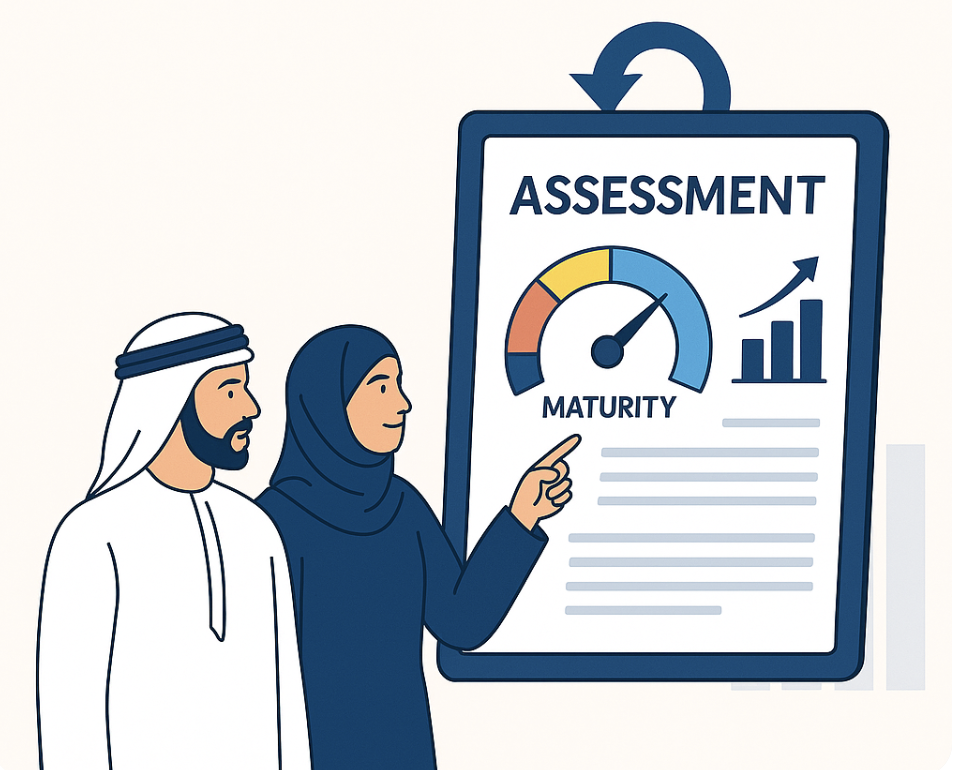
A Team Health Assessment is a structured, evidence-led way to diagnose what’s actually blocking flow and turn it into a practical 30/60/90-day improvement plan. Done well, it gives leaders a clear view of what’s slowing delivery without blaming individuals—and gives teams a shared, safe way to agree on what to change next.
If you’re looking for a broader organisational baseline (across multiple teams, functions, or a full value stream), pair this with an Agile Assessment—either as a short diagnostic or a deeper assessment depending on what you need.
Explore your assessment options here: Agile Assessment
Challenge
Dubai-based organisations (government, semi-government, telecoms, aviation, utilities, financial services, and large conglomerates) often see the same pattern:
1) Delivery looks busy, but outcomes are slow
People are working hard, yet deadlines slip, handovers multiply, and priorities change mid-stream. You’ll hear:
- “Everything is urgent”
- “We’re blocked waiting for approvals”
- “We keep getting late changes”
- “We don’t know what ‘done’ really means”
- “We’re drowning in dependencies”
2) The causes are cross-functional, not just “team-level”
The biggest friction usually sits between groups: business and technology, product and project, governance and execution, vendor and internal teams, PMO and delivery.
That means you won’t fix it with a single training session, a new tool, or a new reporting pack.
3) Cultural dynamics can make the real issues harder to surface
In many Dubai workplaces, you’ll see a mix of:
- Strong respect for hierarchy (people may avoid challenging decisions openly)
- Indirect communication styles (signals are subtle; conflict is often avoided)
- Relationship-based trust (alignment sometimes happens outside formal meetings)
So problems don’t always show up in status reports. They show up in delays, workarounds, and escalating stress.
Approach
A good Team Health Assessment is not “a survey and a slideshow”. It’s a short, structured engagement that combines hard signals (flow and predictability) with soft signals (clarity, collaboration, decision-making, stakeholder alignment).
Here’s a practical approach that works well in the UAE.
Step 1 — Align on outcomes and boundaries (30–45 mins)
Start by agreeing what “better” means and what you’re assessing:
- Which team (or value stream) is in scope?
- What outcomes matter most right now? (speed, predictability, quality, stakeholder confidence, sustainability)
- What is in scope vs out of scope?
- Who needs to be involved to remove blockers?
Output: a short assessment “charter” that prevents politics later (“we thought you were assessing them…”).
Step 2 — Gather evidence (“signals”), not opinions (3–7 days)
You’re looking for consistent patterns, not perfect data.
A) Delivery flow signals (hard)
Use whatever you already have (Jira, Azure DevOps, ServiceNow, Smartsheet/Excel). Look for:
- Lead time / cycle time (how long work takes end-to-end)
- Ageing work items (what gets stuck and for how long)
- WIP levels (too many things started, not enough finished)
- Throughput trend (how much is actually completed over time)
- Churn / rework (late changes, re-opened work, defects)
If the data is messy, that’s a finding in itself—and you can still triangulate with interviews and observation.
B) Ways of working signals (soft)
Use a short anonymous pulse plus a few targeted interviews to understand:
- Role clarity and decision rights (who decides what, and when?)
- Prioritisation and intake (how work gets in; what gets stopped)
- Dependency management (how often you’re blocked by others)
- Stakeholder access and feedback loops (how fast decisions happen)
- Quality and technical health (is delivery sustainable?)
- Psychological safety (can people raise issues early?)
C) Real-world observation (optional, but powerful)
Sit in on a planning/review or a stakeholder check-in. You’ll often spot:
- Decisions being deferred
- Ownership gaps (“who owns this?”)
- Meetings creating work rather than enabling delivery
Output: a one-page “signals snapshot” (what’s helping flow, what’s hurting flow, and where the biggest constraints sit).
Step 3 — Run the Team Health Workshop (2–3 hours)
This is where you turn evidence into aligned action.
A strong workshop sequence:
- What’s working well (protect it)
- Where are we stuck (name it clearly)
- Root causes (not symptoms)
- Smallest changes with the biggest impact
- Owners, dates, and “how we’ll know it improved”
In Dubai environments, facilitation style matters:
- Keep it neutral and safe (no blame, no “gotcha”)
- Balance voices (ensure junior team members can contribute)
- Bring stakeholders in for the parts where decisions are required (so you don’t leave with “nice ideas” and no authority to act)
Output: a prioritised improvement backlog (3–8 actions is usually enough to start) with named owners and timelines.
Step 4 — Convert it into a 30/60/90-day plan (1–2 days)
The plan should be simple and executable. For each action define:
- What we will change (behaviour/process/decision rule)
- Who owns it
- What “done” looks like
- How we’ll measure impact
A common structure:
0–30 days: Stabilise and create clarity
- Reduce WIP (stop starting, start finishing)
- Clarify decision rights (especially priority and scope decisions)
- Introduce lightweight intake/triage for new requests
- Agree a “definition of ready/done” to reduce churn
31–60 days: Improve flow and stakeholder confidence
- Improve dependency management (weekly cross-team sync + escalation paths)
- Tighten review/feedback loops (faster decisions, real demos)
- Improve refinement discipline (smaller slices, clearer acceptance criteria)
61–90 days: Sustain and scale
- Embed a continuous improvement cadence (monthly health check)
- Address structural constraints (team design, funding model, vendor model, governance friction)
- Extend the approach to adjacent teams/value streams
Output: a 1–2 page plan plus a simple set of measures.
Where Team Health fits (and when to use an Agile Assessment instead)
A Team Health Assessment is ideal when:
- One team (or a small cluster) is struggling and you need results fast
- You suspect the problems are operational (flow, WIP, dependencies, unclear ownership)
- You want a practical plan without launching a big transformation programme
An Agile Assessment is better when:
- You need a baseline across multiple teams, a function, or a full value stream
- You want leadership alignment on “what good looks like”
- You need a consistent view across ways of working, governance, roles, and outcomes
The good news: you don’t have to choose a one-size-fits-all approach. Many organisations start with a short diagnostic (fast, lightweight) and expand into a deeper assessment only where the data shows it’s worth it.
Explore your options here: Agile Assessment
Results
A Team Health Assessment should deliver two outcomes: clarity and momentum.
What leaders gain
- A clear view of why delivery is slow (not just where it is slow)
- Shared language across stakeholders (“this is decision latency”, “this is dependency overload”)
- A prioritised plan that avoids “big bang change”
- Early wins that reduce escalation and rebuild trust
What teams gain
- More focus, less thrash
- Clearer ownership and faster decisions
- Less hidden work and fewer last-minute surprises
- A healthier, more sustainable pace
Measures that actually prove improvement (pick 3–5)
Avoid metric overload. Choose a small set and track them weekly/fortnightly:
- Lead time / cycle time (trend down)
- Predictability (more of what you commit gets done)
- WIP (stabilises at a manageable level)
- Ageing work (fewer items stuck for long periods)
- Rework / churn (late changes and re-opened items reduce)
- Stakeholder confidence (simple pulse score every 2–4 weeks)
- Team sustainability (overtime/burnout risk reduces)
Common pitfalls in Dubai organisations (and how to avoid them)
Pitfall 1: Treating the assessment like an audit
If it feels like inspection, people hide problems.
Fix: position it as enablement: “We’re removing friction, not judging people.”
Pitfall 2: Only assessing the team, not the system around it
Many blockers sit in governance, stakeholder behaviour, or dependencies.
Fix: include the right stakeholders for decision-making and escalation.
Pitfall 3: Producing a big report instead of change
Teams don’t need 40 pages. They need clarity and a plan.
Fix: one-page findings + 1–2 page plan + a short improvement backlog.
Pitfall 4: Trying to change everything at once
Too many changes create confusion and fatigue.
Fix: prioritise the smallest interventions that unlock the biggest flow gains.
FAQ
How long does a Team Health Assessment take?
Typically 1–2 weeks end-to-end, depending on data availability and stakeholder access.
Is this only for “Agile teams”?
No. It works for product teams, project teams, operational teams, and hybrid environments.
Do we need Jira/ADO data for this to work?
Helpful, but not mandatory. We can triangulate using interviews, observation, and lightweight sampling.
Team Health Assessment vs Agile Assessment — which should we do?
If you need to fix a specific delivery problem quickly, start with Team Health. If you need an organisation-wide baseline across teams, leadership, and governance, choose an Agile Assessment (short diagnostic or deeper assessment depending on your needs):
Ready to diagnose delivery friction—fast?
If you’d like to run a Team Health Assessment in Dubai (or anywhere in the UAE), we’ll help you identify the biggest constraints to flow and build a practical 30/60/90-day plan that works with your governance realities.